Introduction
If you’re a homeowner or a landlord in Ireland, few questions come up as often during tax season as: “Can I claim mortgage interest relief?”
The answer, as with many things in Irish tax, is: It depends.
Mortgage interest relief has undergone significant changes over the past decade. Once a universal relief for all homeowners, it is now primarily targeted at specific groups—namely first-time buyers (for their main home) and landlords (on rental properties). Meanwhile, many other homeowners no longer qualify at all.
With 2026 on the horizon, understanding the current rules is essential to ensure you’re claiming every euro you’re entitled to—and avoiding costly mistakes on your tax return.
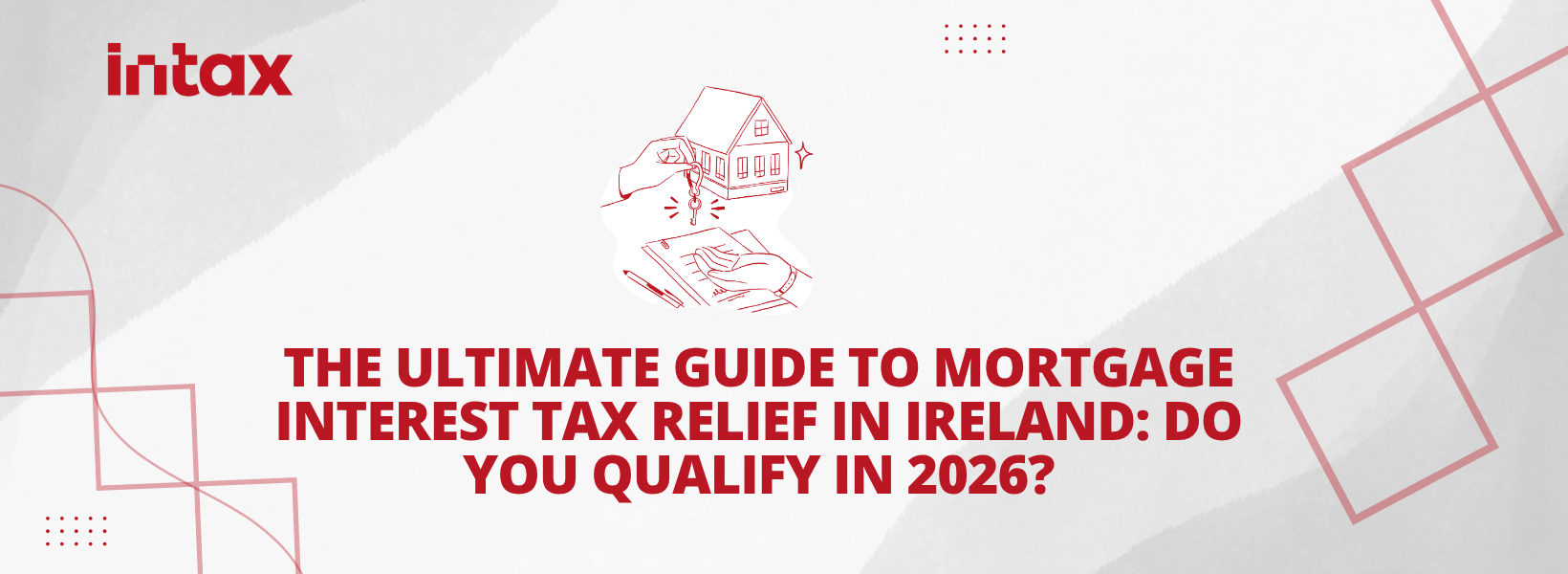
Here is your complete guide to mortgage interest tax relief in Ireland for 2026.
The Short Answer: Do You Qualify?
Let’s start with a quick eligibility checker.
You CAN claim mortgage interest relief in 2026 IF:
- You are a first-time buyer who purchased your home between 2004 and 2012 (and your mortgage was taken out in that period)
- You are a first-time buyer who purchased between 2013 and 2020 (under the more recent Loan-to-Value relief)
- You are a landlord with a mortgage on a rental property
- You have negative equity and qualified under specific transitional arrangements
You CANNOT claim mortgage interest relief in 2026 IF:
- You are an existing homeowner (not a first-time buyer) who bought after 2012
- You purchased your first home after 2020 (this relief has now ended for new buyers)
- Your mortgage is for a holiday home (not your main residence or a rental property)
If you’re unsure, don’t worry—we’ll break down each category in detail.
Category 1: Relief for First-Time Buyers (2004–2012 Purchases)
This is the “classic” mortgage interest relief that many people still remember.
If you took out your first mortgage between 1 January 2004 and 31 December 2012, you may still be claiming relief at source (i.e., your lender reduces your monthly payment automatically).
The rates are:
| Status | Relief Rate (First 7 Years) | Relief Rate (Years 8+) |
| Single / Widowed | 30% of interest paid | 15% of interest paid |
| Married / Civil Partners (Joint Assessment) | 30% of interest paid | 15% of interest paid |
Important: This relief is phased out over time. If you purchased in 2012, your relief may have already ended or be ending soon. Check with your lender or Revenue to confirm your remaining entitlement.
Category 2: Relief for First-Time Buyers (2013–2020 Purchases)
For first-time buyers who purchased between 19 October 2013 and 31 December 2020, a different relief applied—based on the Loan-to-Value (LTV) ratio of your mortgage.
This relief was not paid at source. Instead, you claimed it through your annual tax return (Form 12 or Form 11).
The rates were:
| Loan-to-Value (LTV) | Relief Rate (Years 1–5) | Maximum Interest Qualifying |
| 0–80% | 15% | €3,000 (single) / €6,000 (joint) |
| 80–90% | 15% | €6,000 (single) / €12,000 (joint) |
| 90–100% | 15% | €12,000 (single) / €24,000 (joint) |
Important: This scheme has now closed to new entrants. If you purchased in 2020, you may still be within your 5-year claim window. Check whether you have been claiming correctly each year.
Category 3: Relief for Landlords (Private Residential Tenancies)
If you own a rental property in Ireland, mortgage interest is one of the most valuable deductions you can claim against your rental income.
Unlike homeowner relief (which has strict limits), landlord relief is more straightforward:
- You can claim 100% of the mortgage interest on loans used to purchase, improve, or repair a rented property
- The property must be let under a tenancy (not used as a holiday home or by family members rent-free)
- You claim this deduction on your Form 11 (Self-Assessment tax return)
Example:
If you receive €15,000 in rental income during the year and pay €4,000 in mortgage interest, you are taxed only on €11,000 (€15,000 – €4,000).
Important: If the property is vacant for a period, you can still claim interest for that period provided the property is genuinely available for letting and not being used privately.
Category 4: Negative Equity Transitional Arrangements
A small number of homeowners who purchased between 2004 and 2012 and found themselves in negative equity may qualify for extended relief under transitional arrangements.
This is complex and highly specific to individual circumstances. If you believe you may qualify, it is worth reviewing your situation with a tax advisor.
How to Claim Mortgage Interest Relief
The method of claiming depends on which category you fall into.
If you are a first-time buyer (2004–2012 purchase):
- Check your mortgage statement or contact your lender
- Relief should be applied automatically (Tax Relief at Source – TRS)
- If it has stopped, you may need to confirm your continued eligibility with Revenue
If you are a first-time buyer (2013–2020 purchase):
- Log in to Revenue’s myAccount (for PAYE workers) or ROS (for self-assessed)
- Navigate to “Review Your Tax” or “Rental Income” section (depending on your status)
- Enter the interest paid during the year (your lender will provide an annual statement)
- Revenue will calculate the relief and adjust your tax credits or liability accordingly
If you are a landlord:
- Complete a Form 11 (Self-Assessment) each year
- Include mortgage interest under “Rental Income Expenses”
- Keep detailed records in case of a Revenue audit
Common Mistakes to Avoid
1. Claiming for the wrong years
Many homeowners assume relief continues automatically. Always verify your eligibility period.
2. Claiming on the wrong property
Relief for homeowners applies only to your Principal Private Residence (PPR) . Holiday homes and second properties do not qualify.
3. Overclaiming as a landlord
Only interest on loans used for the rental property qualifies. If you refinanced and released equity for personal use, that portion is not deductible.
4. Missing the deadline
Relief must be claimed within the relevant tax year or via a four-year review. If you missed a year, you can often go back and claim it—but don’t delay.
Will Mortgage Interest Relief Return for New Buyers?
This is the million-euro question.
Currently, no mortgage interest relief exists for buyers who purchased after 2020. However, with rising interest rates and housing affordability becoming a major political issue, there has been speculation that some form of relief may return in future budgets.
Intax.ie will continue to monitor Budget announcements and update clients as soon as any changes are confirmed.
How Intax.ie Can Help?
Tax rules around mortgage interest are layered, and it’s easy to miss relief you’re entitled to—or accidentally claim relief you no longer qualify for.
At Intax.ie, we help Irish homeowners and landlords:
- Review past tax returns for missed mortgage interest claims
- Calculate allowable interest for rental properties
- File Form 11 and myAccount returns accurately
- Plan for future property purchases with tax efficiency in mind
Contact our tax team today to ensure you’re not overpaying on your mortgage or underclaiming on your rental income.
Summary: Who Qualifies for Mortgage Interest Relief in 2026?
| Borrower Type | Purchase Period | Relief Available? |
| First-time buyer (main home) | 2004–2012 | Yes (phased, via lender) |
| First-time buyer (main home) | 2013–2020 | Yes (via tax return, 5-year limit) |
| First-time buyer (main home) | Post-2020 | No |
| Existing homeowner (not first-time) | Any | No |
| Landlord | Any | Yes (100%, via Form 11) |
| Holiday home owner | Any | No |