The Minister for Finance has unveiled Budget 2027, delivering an €8.5 billion fiscal package headlined by €1.65 billion in direct tax reductions and an expansive €1.3 billion personal income tax relief package. Designed against a backdrop of global economic headwinds and domestic cost-of-living pressures, Budget 2027 balances take-home pay protections for employees with landmark capital tax cuts, structural inheritance threshold increases, and critical employer PRSI mitigation.
For corporate boards, business founders, and family offices, Budget Day is not merely about standard allowance adjustments—it signals fundamental statutory shifts across Capital Gains Tax (CGT), Capital Acquisitions Tax (CAT), social insurance overheads, innovation credits (R&D), and retail investment frameworks.
Below, Intax.ie breaks down the commercial, capital, and corporate tax announcements from Budget 2027 and provides an executive roadmap for Irish enterprises and taxpayers.
1. Capital Taxation & Wealth: Landmark Reductions to CGT and Exit Tax
The centerpiece of Budget 2027 for founders, shareholders, and private investors is a decisive reduction in capital taxation, structured to stimulate enterprise liquidity and private investment:
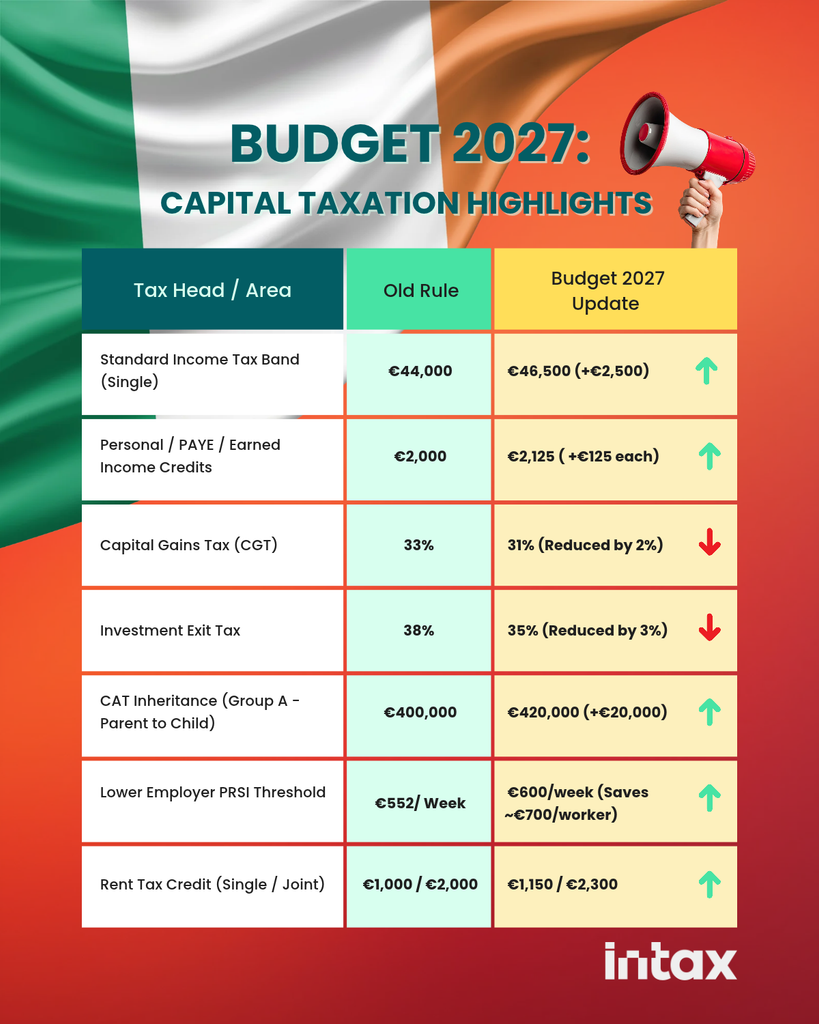
- Capital Gains Tax Cut to 31%: The standard rate of Capital Gains Tax (CGT) has been officially reduced by two percentage points from 33% to 31% (effective for qualifying asset disposals executed on or after 7 October 2026). This rate cut applies across business disposals, private company share realisations, and non-development property, directly enhancing post-tax exit proceeds for enterprise sellers.
- Life Assurance & Investment “Exit Tax” Slashed to 35%: In an effort to address the historical penalty on domestic collective investments, the exit tax regime (including the 8-year deemed disposal regime on investment funds and life policies) has been reduced from 38% down to 35% (effective 1 January 2027).
- New State Retail Investment Accounts (July 2027): The Department of Finance introduced a new tax-advantaged retail equity savings vehicle. Individuals can invest up to €12,000 annually, with 0% tax on accumulated capital up to €50,000. Balances above €50,000 will be subject to a flat 1% annual charge regardless of underlying investment performance.
- Capital Acquisitions Tax (CAT) Threshold Increases: Statutory tax-free thresholds for gifts and inheritances received on or after 7 October 2026 have expanded:
- Group A (Parent to Child): Raised from €400,000 to €420,000 (+€20,000).
- Group B (Siblings, Nieces, Nephews, Grandchildren): Raised from €40,000 to €44,000 (+€4,000).
- Group C (All other relationships / Unrelated parties): Raised from €20,000 to €22,000 (+€2,000).
2. Employer Payroll & PRSI: Mitigating Minimum Wage Overhead
As detailed in guidance released by the Department of Finance, commercial employers face revised payroll thresholds taking effect on 1 January 2027:
- National Minimum Wage Adjustment: The national statutory minimum wage rises by €0.79 to €14.94 per hour.
- Employer PRSI Band Relief: To prevent employers from being pushed into higher social insurance brackets due to statutory wage increases, the lower Employer PRSI contribution threshold will rise from €552 per week to €600 per week.
- Corporate Impact: This adjustment saves businesses an estimated €650 to €700 per qualifying worker annually, curbing labor cost inflation across hospitality, retail, manufacturing, and facilities services.
- Enhanced Reporting Requirements (ERR): Real-time digital submissions under Section 897A TCA remain strictly monitored by Revenue. All non-taxable staff allowances, travel and subsistence claims, and small benefits must continue to be logged through ROS on or before payment dates.
3. Personal Income Tax Bands, Credits & USC Adjustments
The €1.3 billion income tax package targets middle-income earners and dual-earner working households:
- Standard Rate Cut-Off Point (SRCOP): The 20% standard rate income tax band increases by €2,500, moving from €44,000 to €46,500 for single individuals (and up to €55,500 for married couples with one earner and €93,000 for dual-income couples).
- Core Tax Credits Raised by €125: The Personal Tax Credit, Employee (PAYE) Tax Credit, and Earned Income Tax Credit (for self-employed professionals and proprietary directors) each increase by €125 to €2,125 per year.
- Home Carer Tax Credit (+€100): Rises to €2,050 per year to support single-income households caring for children or vulnerable dependents.
- Universal Social Charge (USC) Band Realignment: The ceiling for the 2% USC band expands by €1,600 from €28,700 to €30,300. This keeps minimum wage workers outside the 3% USC bracket.
- Net Take-Home Value:
- An individual earning €50,000 will save over €700 annually in combined Income Tax and USC.
- A dual-earner household with a combined income of €100,000 will retain approximately €1,500 per year in additional net disposable income.
4. Innovation, R&D and Enterprise Investment Schemes
To support indigenous scaling companies and international trading enterprises, Budget 2027 bolsters key corporation tax credits:
- Enhanced R&D Tax Credit Liquidity (Section 766 TCA):
- The first-year direct cash refund threshold for R&D claims rises from €87,500 to €105,000, accelerating early working capital for innovative startups.
- Subcontracting expenditure limits to third-level institutions and specialized third parties are raised from 15% to 20%, and from €100,000 to €200,000.
- Extension of Key SME Incentives: The Employment Investment Incentive (EII), Start-Up Relief for Entrepreneurs (SURE), Start-Up Capital Incentive (SCI), and Angel Investor Relief schemes have been formally extended under revised EU General Block Exemption (GBER) State Aid regulations, providing ongoing funding channels for early-stage Irish companies.
5. Property, Housing & Everyday Tax Measures
As published across CitizensInformation.ie and the Irish Times, Budget 2027 incorporates targeted revisions across housing supports, education, and consumer excise:
- Rent Tax Credit Increased to €1,150: The Rent Tax Credit rises by €150, offering up to €1,150 per year for single renters and €2,300 for jointly assessed couples (fully claimable by parents supporting student children living in third-level accommodation).
- Help to Buy (HTB) Cap Raised to €35,000: The maximum tax rebate for first-time buyers constructing or purchasing a new residential home increases by €5,000 to €35,000 with immediate effect.
- Rent-a-Room Relief Threshold to €16,000: The gross annual tax-free income ceiling under Rent-a-Room Relief increases to €16,000 per year, now covering newly constructed detached auxiliary modular units built on home grounds.
- Permanent €150 Cut to Third-Level Student Fees: The student contribution fee is capped at a maximum of €2,350, with an immediate €150 direct refund for students who already paid their 2026/2027 academic contribution in full.
- Childcare Services Relief Raised to €20,000: Home-based childcare providers can now earn up to €20,000 per year tax-free, with the previous cap on the number of children removed.
- Excise, Fuel & Banking Levies:
- Cigarettes: Up by €1.00 per pack of 20 (effective 7 October 2026).
- Vape Excise Duty: A new dedicated excise tax of €0.20 per ml of e-liquid takes effect on 1 January 2027.
- Fuel & Carbon Tax: Reductions in petrol and diesel excise duties are extended until 28 February 2027. The carbon tax on home kerosene and natural gas has been reduced to €48.50 per tonne.
- Bank Levy: Formally extended for another year to collect €200 million.
Navigating Budget 2027: How Intax.ie Unlocks Real Value for Irish Taxpayers
Budget 2027 delivers substantial fiscal opportunities—from a 31% Capital Gains Tax rate and expanded CAT thresholds to payroll PRSI protections and R&D cash refunds. However, statutory policy only delivers financial value if corporate structures, remuneration policies, and filing schedules are properly aligned before the Finance Bill is enacted into law.
This is where a specialized, technology-enabled corporate tax advisory and tax preparation service like Intax.ie becomes an essential commercial partner.
1. Commercial Exit & Capital Gains Restructuring
With the standard CGT rate now reduced to 31%, timing is critical for business sales, share transfers, and property disposals. Intax.ie works directly with founders and shareholders to model transaction timings, integrate Revised Entrepreneur Relief (Section 597AA TCA) for 10% CGT yields, and execute share-for-share reorganizations that defer tax legally.
2. Complete Corporate Payroll & ERR Audit Readiness
Managing the transition to the €14.94 minimum wage alongside the revised €600/week Employer PRSI bracket requires precise payroll calibration. Intax.ie’s payroll advisory team ensures that your accounting systems claim the maximum PRSI savings (up to €700 per eligible worker) while remaining fully compliant with Revenue’s real-time Enhanced Reporting Requirements (ERR) on ROS.
3. R&D Credit Monetisation & Grant Optimization
For technology, life sciences, and engineering firms, accessing the expanded €105,000 first-year cash refund under Section 766 TCA requires comprehensive scientific and technical documentation. Intax.ie manages the preparation, technical scoping, and ROS claim submissions to ensure R&D refunds are paid rapidly without exposing your business to audit clawbacks.
4. Family Succession & CAT Wealth Transfer Roadmaps
With Group A parent-to-child thresholds expanded to €420,000, intergenerational business handovers require proactive management. Our senior tax practitioners structure combined Agricultural Relief, Business Relief, and Retirement Relief strategies to transfer family enterprises tax-neutrally to the next generation.
5. Individual & Dual-Assessed Tax Optimization
For company directors, high-earning executives, and private individuals, shifting to the €46,500 standard band and utilizing the €2,125 tax credits requires review of standard rate cut-off allocation. Intax.ie conducts comprehensive annual tax reviews to balance director emoluments, pension contributions, and rental reliefs—eliminating overpaid tax and preventing unexpected Revenue balancing assessments.
Take Control of Your Tax Position Today
Budget 2027 rewards companies and individuals that act decisively. Do not leave your tax strategy to year-end assumptions or miss out on statutory refunds and rate cuts.
👉 Schedule a Post-Budget Consultation with Intax.ie Today to review your corporate balance sheet, model your exit gains, and optimize your 2027 tax profile.
(Looking to claim backdated PAYE refunds, remote working relief, or historical rent credits under the 4-year rule? Visit our dedicated personal tax refund portal at TaxReturned.ie.)