As a sole trader enterprise or commercial partnership expands, the legal protection, commercial credibility, and tax efficiency of a private limited company (LTD) become increasingly necessary. However, transferring a mature business—including goodwill, commercial premises, contracts, and equipment—from an individual to a corporate entity represents a formal disposal for tax purposes.
Without specific statutory relief, this transfer triggers an immediate Capital Gains Tax (CGT) assessment at 33% on the market value of the appreciated assets, creating a major cash tax liability before the new corporate structure generates revenue.
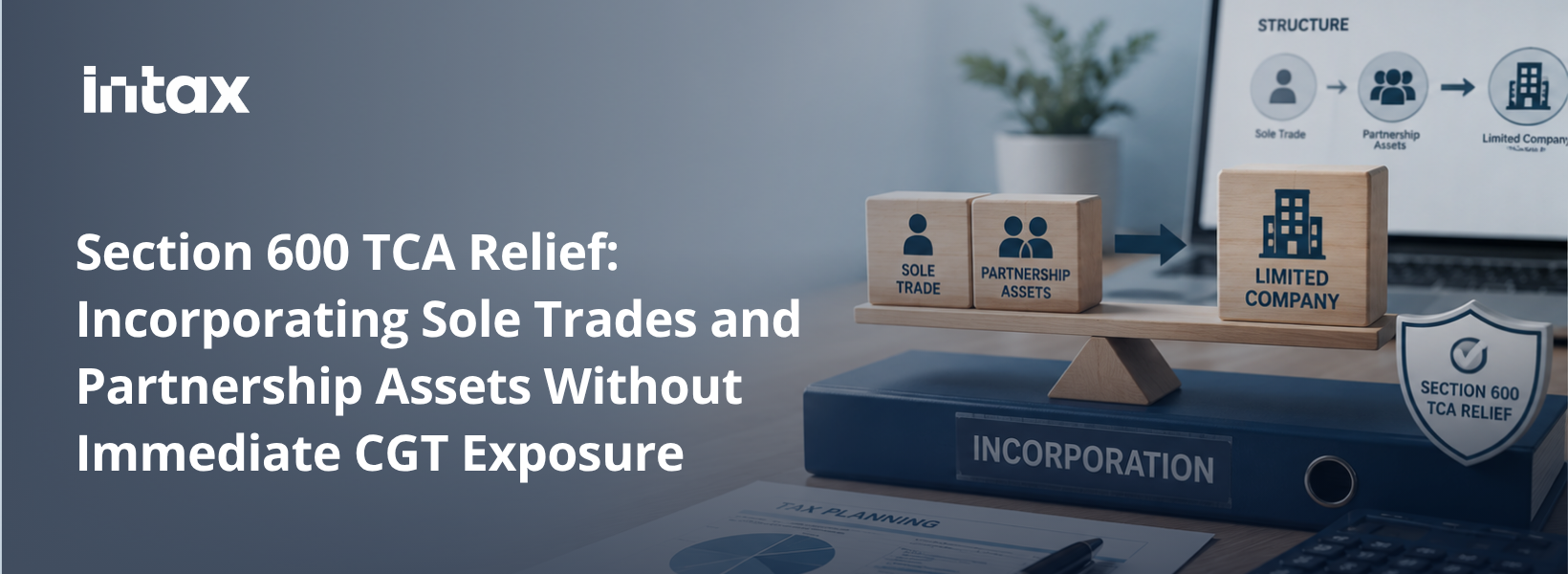
Fortunately, Section 600 of the Taxes Consolidation Act 1997 (TCA) provides a primary statutory rollover mechanism. Known as Incorporation Relief, Section 600 allows business owners to transfer a business as a going concern to a company wholly or partly in exchange for shares, rolling over the tax liability until the shares are eventually sold.
At Intax.ie, we assist growing business owners in navigating the technical step-up requirements of Section 600 TCA to execute seamless, tax-neutral corporate transitions.
1. The Statutory Formula: How Rollover Relief Operates
Section 600 TCA operates by deferring the capital gain that would otherwise arise on the transfer of business assets into the corporate shell.
As detailed in Revenue Tax & Duty Manual (TDM) Part 19-06-04, the deferred gain is subtracted from the original cost base of the new shares issued to the business owner:
Base Cost of New Shares = Market Value of Acquired Shares – Deferred Capital Gain
- 100% Share Consideration: If the business is transferred wholly in exchange for new corporate shares, 100% of the capital gain is deferred.
- Mixed Consideration (Cash + Director Loans): If the owner receives cash, credit balances on loan accounts, or debt notes alongside shares, the relief is pro-rated. The portion of the gain attributable to non-share consideration is charged to CGT immediately at 33%.
| INCORPORATION RELIEF MECHANICS (SEC 600) | |
| Factor | Requirement / Impact |
| Transfer Scope | Business transferred as a going concern |
| Asset Allocation | All assets (except cash) must transfer |
| Consideration Type | Shares issued (100% = Full CGT Rollover) |
| Deferred Gain Mechanics | Subtracted from base cost of new shares |
| Stamp Duty Impact | Subject to 1% – 7.5% depending on assets |
2. Core Conditions: The Going Concern Mandate
To qualify for Section 600 relief, the incorporation process must satisfy strict statutory parameters enforced by Revenue:
- Transfer as a Going Concern: The business must be transferred as an active, operational enterprise together with all underlying trading assets.
- The “Whole of Assets” Rule: As highlighted on CitizensInformation.ie and in Revenue manuals, all assets of the business (or the whole of its assets other than cash) must be transferred simultaneously to the new corporate entity. Excluding valuable assets like goodwill or commercial land to retain them personally breaks the relief.
- The Share Consideration Rule: The transfer must be made wholly or partly in exchange for new ordinary shares issued by the acquiring company to the transferring owner.
- Bona Fide Commercial Purpose: Under Section 600(6) TCA 1997, the relief is not available unless the transfer is effected for genuine commercial reasons and does not form part of a tax avoidance scheme.
3. Overlapping Tax Implications: Stamp Duty and Capital Allowances
While Section 600 completely addresses Capital Gains Tax, incorporating a business triggers secondary tax heads that require careful management:
- Stamp Duty Exposure: Transferring real estate or goodwill into a company incurs Stamp Duty (1% for residential, 7.5% for commercial land and certain goodwill transfers). Ensuring asset transfer agreements are structured correctly prevents unexpected Stamp Duty liabilities.
- Capital Allowances Succession (Section 312 TCA): Under Section 312 TCA, the sole trader and the company can make a joint election to transfer plant, machinery, and equipment at their tax-written-down value (TWDV), avoiding clawbacks or balancing charges.
- VAT on Transfer of Business (Section 26 VATCA): Under the Transfer of Business (TOB) rules, the transfer of trade assets from a taxable sole trader to a taxable company is exempt from VAT, preserving operational cash flow.
Trade Creditors vs. Bank Loans Concession
According to Revenue TDM Part 19-06-04, when a business transfers to a company, taking over business liabilities is technically treated as non-share consideration. However, by administrative concession, genuine bona fide trade creditors taken over by the company will not be treated as non-share consideration if the business is transferred in exchange for shares only. Bank loans or personal tax liabilities taken over do not enjoy this concession and must be carefully structured.
To evaluate how data record-keeping supports asset transfers during corporate incorporation, read our guide to Mastering VAT in Ireland’s Digital Economy.
The Intax.ie Verdict: Precision Structuring Avoids Tax Exposure
Incorporating a sole trade or partnership under Section 600 TCA is an effective way to enter a corporate structure tax-neutrally. However, taking back a director’s loan without proper pro-rating calculations will trigger an unexpected CGT assessment.
For a broader perspective on how corporate entities are taxed post-incorporation, see our analysis of Ireland’s 12.5% vs. 15% Corporation Tax landscape.
Are you preparing to incorporate an expanding sole trade or partnership?
Do not let unmapped asset valuations or missing joint elections create an unbudgeted tax liability. Contact the Intax.ie team today to structure your corporate transition smoothly.